
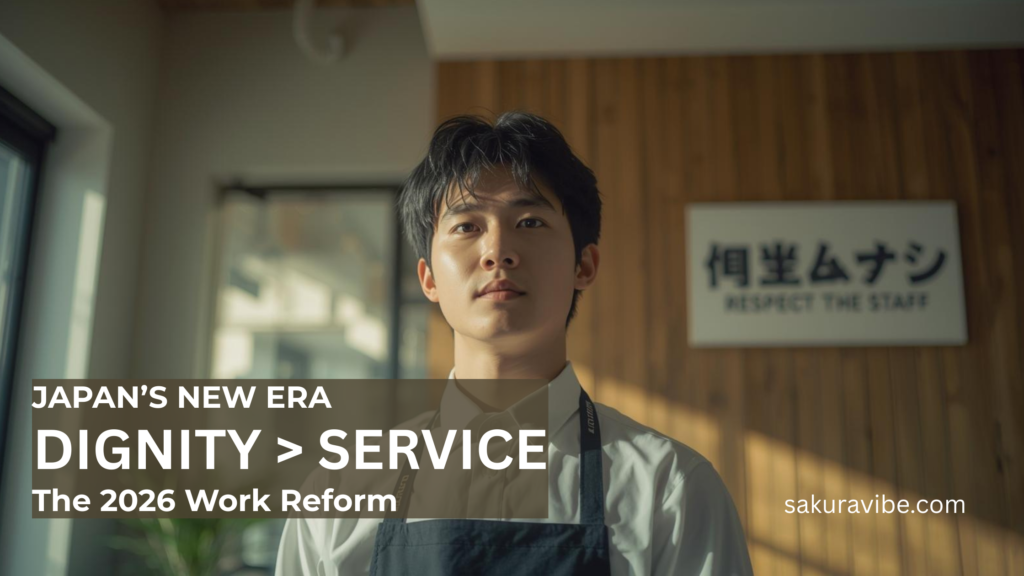
For decades, if you stepped into a department store in Ginza or a tiny ramen shop in Fukuoka, you weren’t just a consumer. You were a deity. The phrase Okyakusama wa kamisama—”The customer is God”—wasn’t just a catchy business slogan; it was the invisible iron pillar holding up the entire Japanese social contract. It gave us the world’s best service, but it came at a staggering, silent cost.
As we move through February 2026, that pillar hasn’t just cracked; it’s been officially dismantled.
Welcome to the era of Symmetrical Respect. In the wake of the landmark anti-harassment laws taking full national effect this year, Japan is finally admitting something radical: The person behind the counter is just as human as the person in front of it.
Table of Contents
ToggleThe Ghost of the "Dogeza"
To understand why 2026 feels like a revolution, we have to remember where japanese people came from. Only a few years ago, “Customer Harassment”—or Kasuhara—was a dark, daily reality.
We’ve all seen the viral videos or heard the office hushed-tones: a convenience store clerk forced into dogeza (a prostrate, forehead-on-the-floor apology) over a misplaced loyalty card, or a train station attendant enduring a thirty-minute verbal lashing because a line was delayed by snow.
For a long time, the Japanese “Work-Life” balance was weighted entirely toward the “Life” of the customer, often at the expense of the “Life” of the worker.
The psychological toll was immense. But as the labor shortage hit a fever pitch in 2024 and 2025, companies realized a cold, hard truth: You cannot afford to let your “Gods” abuse your “Disciples” when you have no disciples left to hire.
October 2026: The Law That Changed the Vibe
The shift became legal reality with the October 2026 National Labor Policy amendments. For the first time, “Customer Harassment” isn’t just a breach of etiquette; it’s a violation of labor safety.
Walking into a Tokyo cafe today, you might notice a small, elegant sign or a digital ticker near the register.
It doesn’t say “The Customer is Always Right.” Instead, it outlines a “Code of Conduct.” Under the new 2026 mandate, companies are now legally required to:
- Define Abusive Behavior: No more “gray areas” for verbal abuse or social media threats.
- Empower the “Right to Refuse”: Staff are now trained—and legally protected—to terminate an interaction the moment it turns toxic.
- Prioritize Mental Health: If a worker is harassed, the company must provide immediate “cool-down” time and counseling, or face heavy fines.
This isn’t just bureaucracy. It’s a shield. It’s the sound of a million service workers finally exhaling a breath they’ve been holding for thirty years.
The Gen Z Rebellion: "I’m Not Your Sacrifice"
While the law provided the framework, it was the younger generation that provided the spark. Japan’s Gen Z has looked at the “Salaryman” lifestyle of their parents—the endless overtime, the forced smiles, the soul-crushing compliance—and they’ve swiped left.
In 2026, the “Quiet Quitting” movement in Japan has evolved into “Selective Working.” Young professionals are gravitating toward companies that explicitly advertise a “No-Kasuhara” environment. They aren’t looking for the highest paycheck; they’re looking for the highest level of psychological safety.
Recent workforce data supports this shift. According to a 2026 study by the Japan Institute for Labour Policy, nearly 68% of service workers under the age of 30 now cite “workplace psychological safety” as their top priority, even over salary increases.
The research suggests that for Gen Z, the appeal of a job is no longer tied to the prestige of the brand, but to the company’s internal “Kasuhara” policies.
In fact, recruitment data from early 2026 shows that companies which explicitly promote their “managerial support systems” for harassed staff see a 30% higher application rate from young professionals.
For this new generation, loyalty is earned not through a paycheck, but through a guarantee that if a customer crosses the line, the manager will stand in front of the employee, not behind them.
Is "Omotenashi" Dying?
The critics—mostly the “Old Guard”—worry that by killing the “Customer-God,” we are killing Omotenashi, Japan’s world-famous wholehearted hospitality. They fear a future of cold, transactional service where the warmth of the Japanese welcome is replaced by robotic efficiency.
But they’re missing the point.
True Omotenashi was never supposed to be a master-slave relationship. It was supposed to be an anticipation of needs based on empathy. You cannot have empathy if one side is terrified of the other. What we’re seeing in 2026 isn’t the death of hospitality; it’s the birth of Sustainable Hospitality.
By removing the fear of abuse, we allow the worker to be genuinely kind again. When you aren’t braced for a verbal punch, you can actually offer a real smile. We are moving from “Service with a Mask” to “Service with a Soul.”
The Economic Reality: Survival of the Kindest
Let’s talk numbers. In this tight 2026 labor market, employee retention is the only metric that matters. Replacing a staff member in Japan now costs nearly 1.5x their annual salary when you factor in recruitment and training in a shrinking population.
Companies that have embraced the “Customer is a Guest, Not a God” philosophy are seeing turnover rates drop by 40%. Meanwhile, the “Black Companies” that still cling to the old ways are finding their storefronts shuttered, not for lack of customers, but for lack of people willing to serve them.
The market has spoken: If you want to stay in business, you have to be a protector of your people.
Conclusion: A New Social Contract
Work-Life Evolution in Japan has reached a beautiful, if slightly friction-filled, destination. We’ve realized that “Work” shouldn’t be a place where you check your dignity at the door.
As we look toward the rest of 2026, the “Customer-God” is being replaced by something much better: the Customer-Partner. It’s a world where a “thank you” is expected from both sides of the counter. It’s a world where the “Life” in Work-Life Balance includes the right to a shift free from fear.
The next time you’re in Japan, remember: enjoy the service, appreciate the detail, and savor the politeness. But remember that the person serving you is a human being with a life, a family, and a limit.
The God is dead. Long live the Human.